Appearance
LoopTroop Docs
A smart local engine that automates big coding tasks from start to finish. LLM councils plan it. Ralph loops perfect it. OpenCode worktrees ship it.
LoopTroop helps you turn a coding ticket into a planned, reviewable, agent-executed pull request.
Instead of trusting a single, endless AI chat session, where the conversation history gets bloated, the AI gets confused, and code quality falls off a cliff, LoopTroop breaks the job into clean, separate stages. Planning turns an interview into a PRD, which is then split into the smallest manageable milestones, called "beads." Execution runs each bead through multiple targeted auto-fix loops. A final review ties it all together.
| Architectural Layer | Core | Technical Lifecycle |
|---|---|---|
| 1. Planning | LLM Councils Plan It | Human Input ➔ AI Interview ➔ PRD ➔ Atomic Beads |
| 2. Execution | Ralph Loops Perfect It | Isolated Bead Work ➔ Multi-Loop Automated Testing & Fixing |
| 3. Shipping | OpenCode Worktrees Ship It | Code Isolation ➔ Final Verification Pass ➔ Main Branch Handoff |
Free and fully open-source.
Run LoopTroop in a Sandboxed Environment (VM)
LoopTroop executes agent code changes with full local user privileges to allow unattended runs. For maximum security, it is highly recommended to run LoopTroop inside a disposable VM, cloud environment, or sandboxed workspace. See Getting Started for details.
Start Here
Install it, then run looptroop open. This starts LoopTroop in the background if it is not already running and opens a signed-in browser on it.
bash
curl -fsSL https://www.looptroop.ovh/install | sh
looptroop open
powershell
irm https://www.looptroop.ovh/install.ps1 | iex
looptroop open
bash
npm install -g looptroop
looptroop open
bash
brew install looptroop-ai/tap/looptroop
looptroop open
powershell
scoop bucket add looptroop https://github.com/looptroop-ai/scoop-bucket
scoop install looptroop
looptroop open
bash
bun add -g looptroop
looptroop open
bash
pnpm add -g looptroop
looptroop open
bash
yarn global add looptroop
export PATH="$(yarn global bin):$PATH"
looptroop open
# Yarn Classic, Bash/zsh. Add the PATH line to your shell profile.
# Use npm in PowerShell.
bash
docker pull looptroopai/looptroop:latestGetting Started walks through the first run, and Installation covers every channel, what each one requires, upgrading, uninstalling and the standalone executable. To work on LoopTroop itself rather than use it, see Working on LoopTroop itself.
If you are new to LoopTroop, use this order:
- Getting Started for installing it and the first run.
- Core Philosophy for the system-level design goals.
- Context Engineering for LoopTroop's minimum-context model discipline.
- Ticket Flow for the full lifecycle from draft to completion.
What LoopTroop Is
LoopTroop is a local GUI orchestrator for long-running, high-correctness AI software delivery, taking you from a raw idea to merged code.
Unlike high-speed coding tools that optimize for immediate chat responses, LoopTroop is built for complex, multi-file feature work where alignment and correctness are paramount. It optimizes for a "slow and perfect" paradigm, intentionally sacrificing raw speed to deliver a final result that matches exactly how you envisioned it.
Great Context Engineering = Zero AI Slop: LoopTroop employs precise context curation at every stage, feeding the agent only the absolute minimum context it needs. See Context Engineering for details.
Project Status
LoopTroop is early alpha software, but it is usable for real work. The full ticket lifecycle is implemented, but some bugs are still likely. The core primitives (planning, execution, retries) are functional.
Configured limitations: In LoopTroop alpha, LLM Councils support 2 to 10 distinct models, including the main implementer. Each project may have only one active ticket in the execution band at a time; additional tickets must wait until it finishes or is canceled.
How It Works
Screenshots
Projects dialog
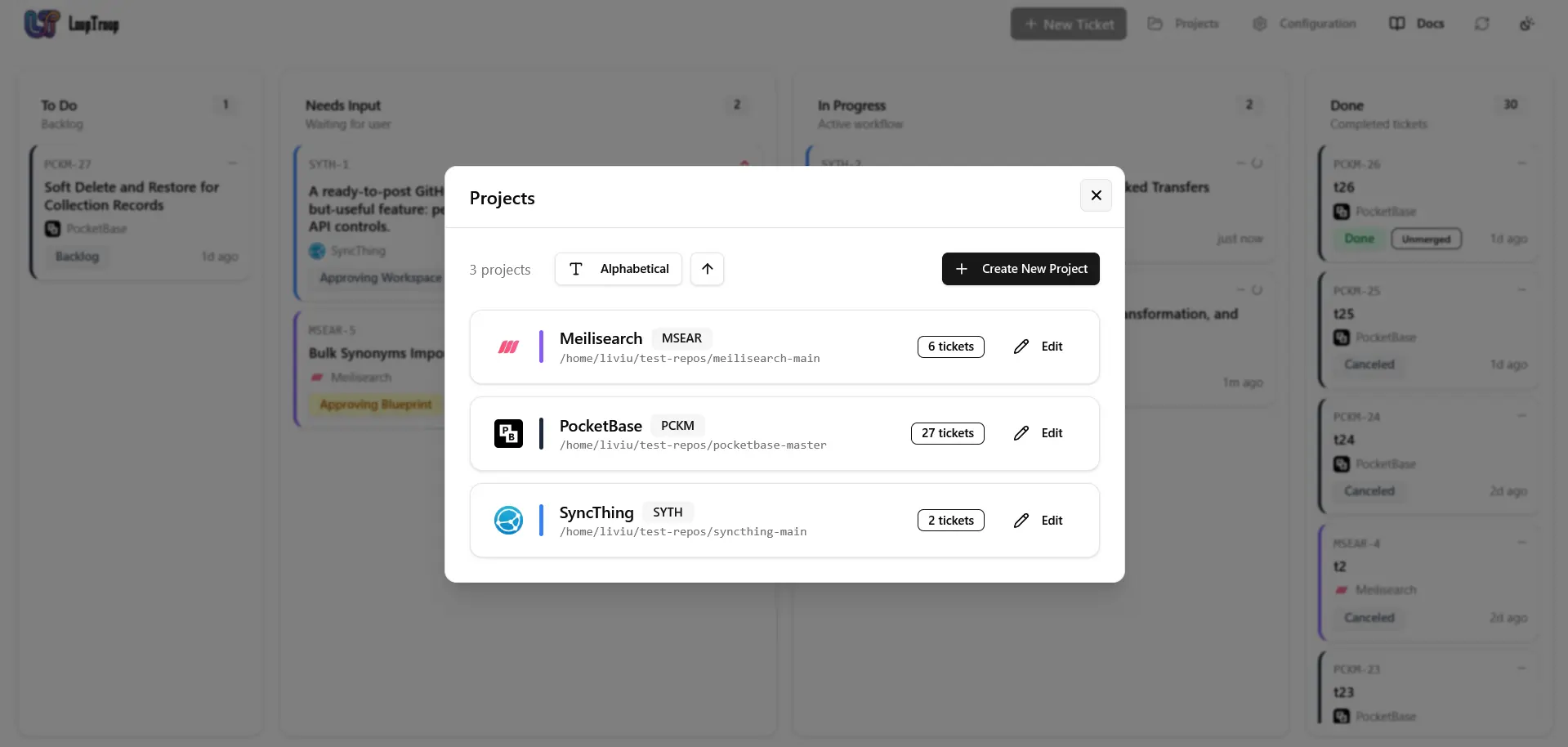 Manage attached repositories, review ticket counts, and add new projects from the dashboard.
Configuration dialog
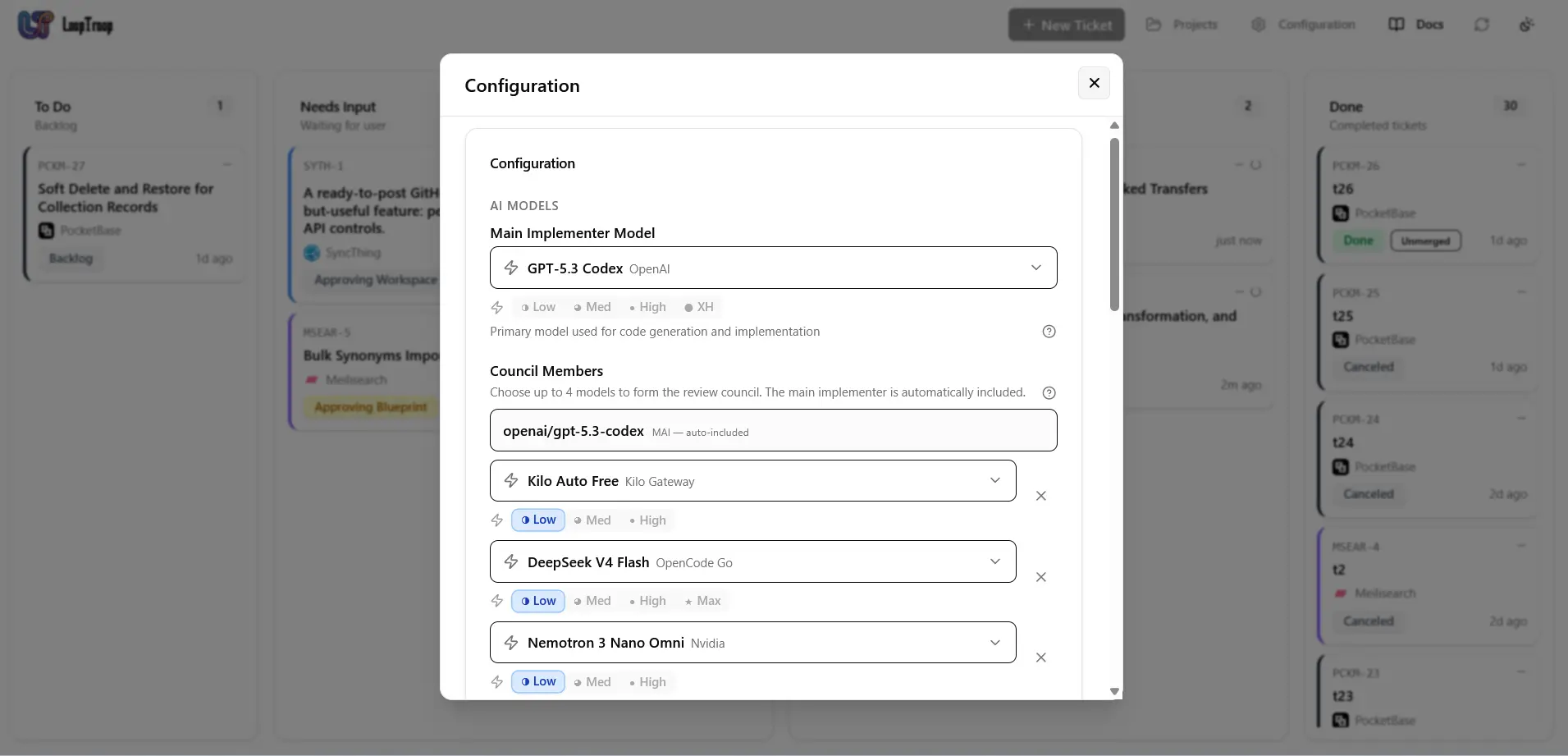 Choose the main implementer model, council members, and effort levels for local orchestration.
Interview workspace
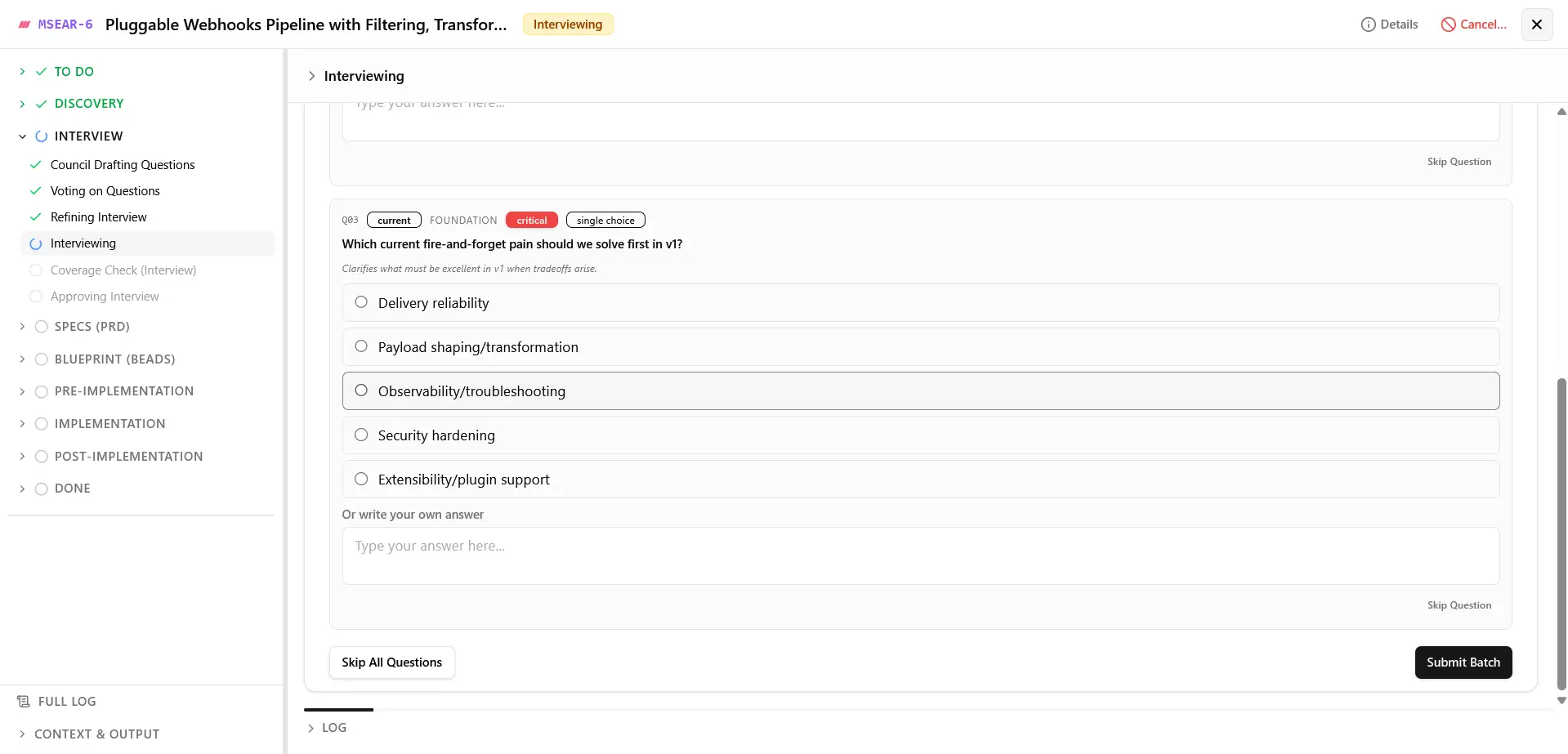 Answer focused planning questions before specs and implementation plans are approved.
Ticket workflow detail
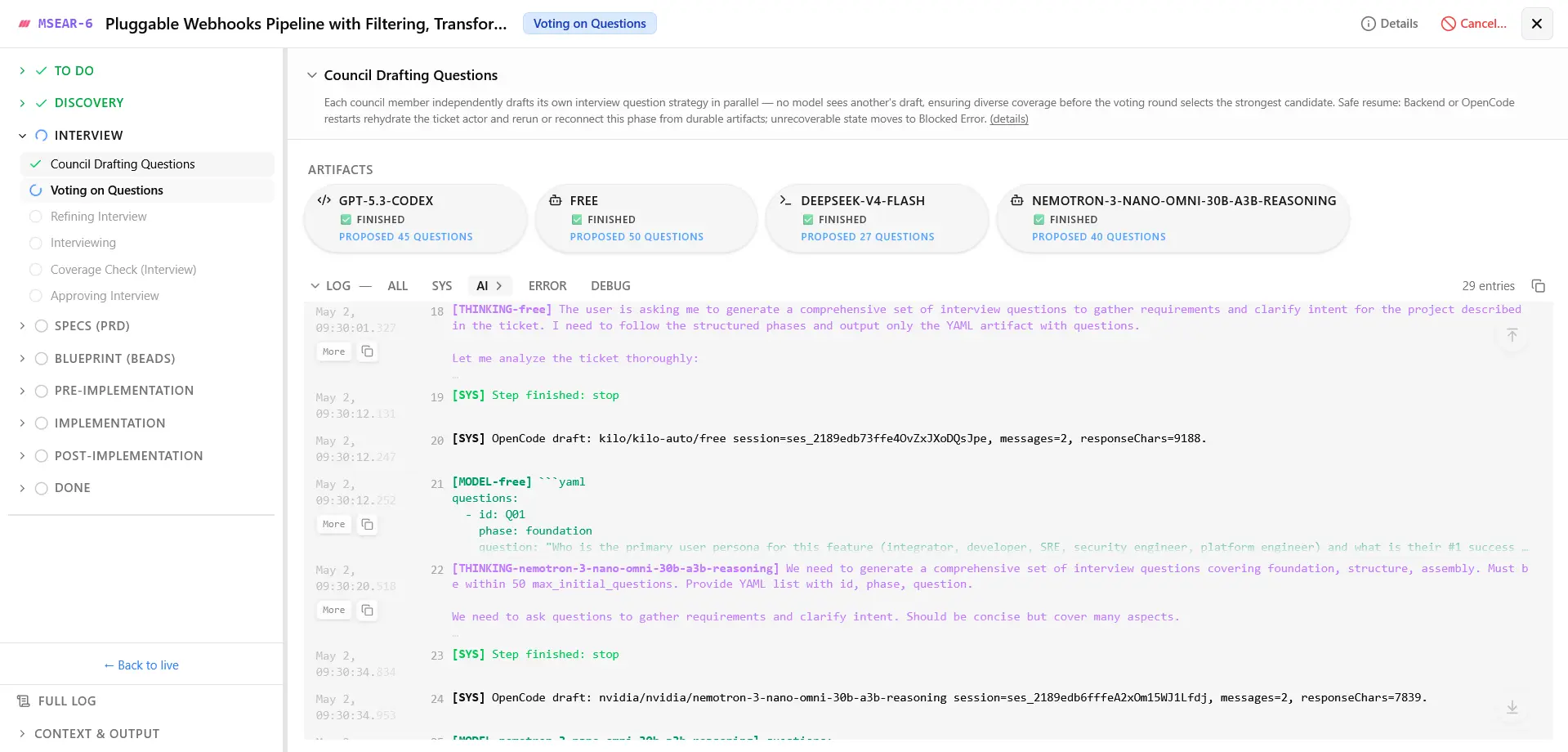 Track council progress, generated artifacts, and live execution logs inside a ticket.
Implementation review
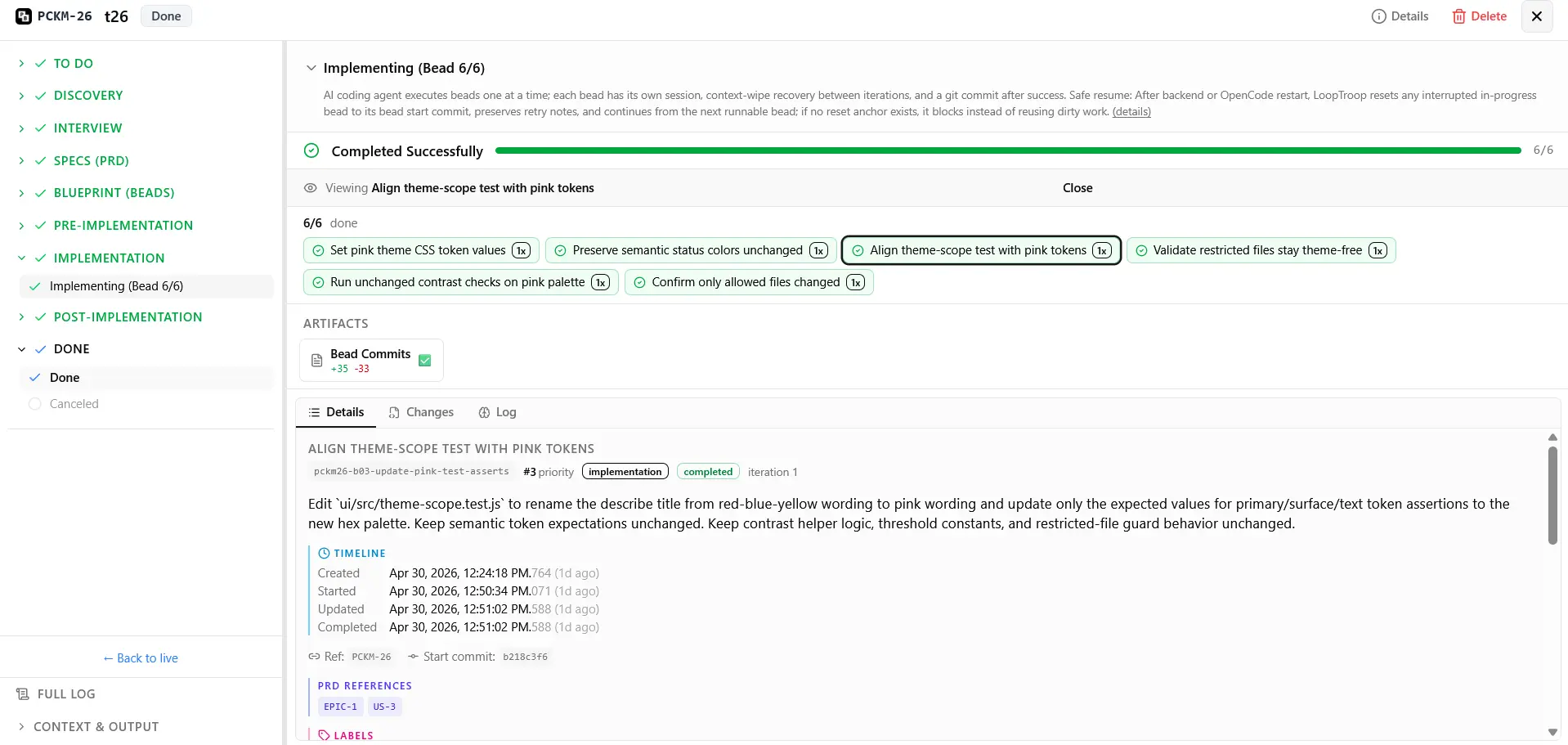 Review bead completion, commits, changes, and final implementation details before closing the workflow.
Bead execution detail
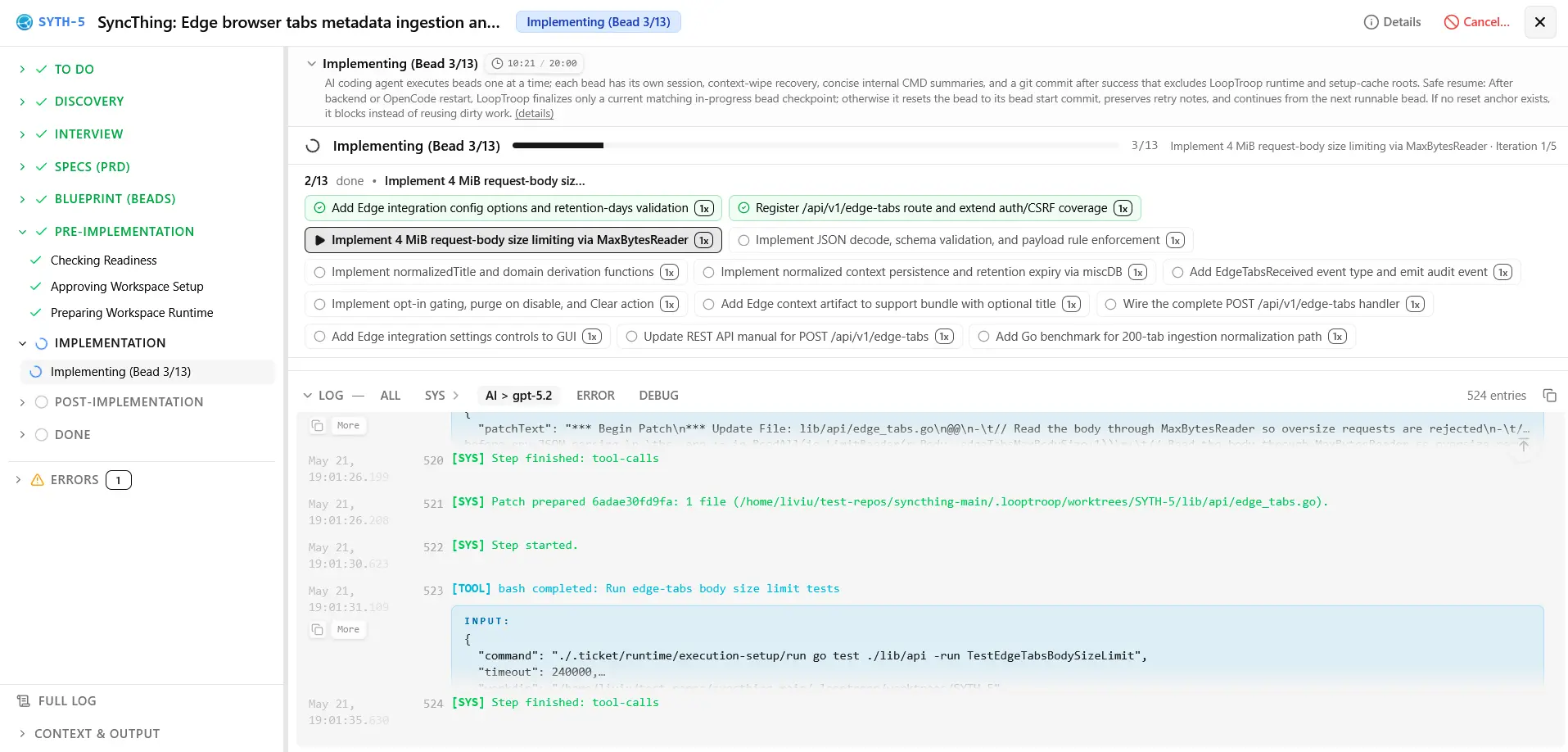 Inspect bead-level progress, task status, and live execution logs while an implementation bead runs.
Bead error view
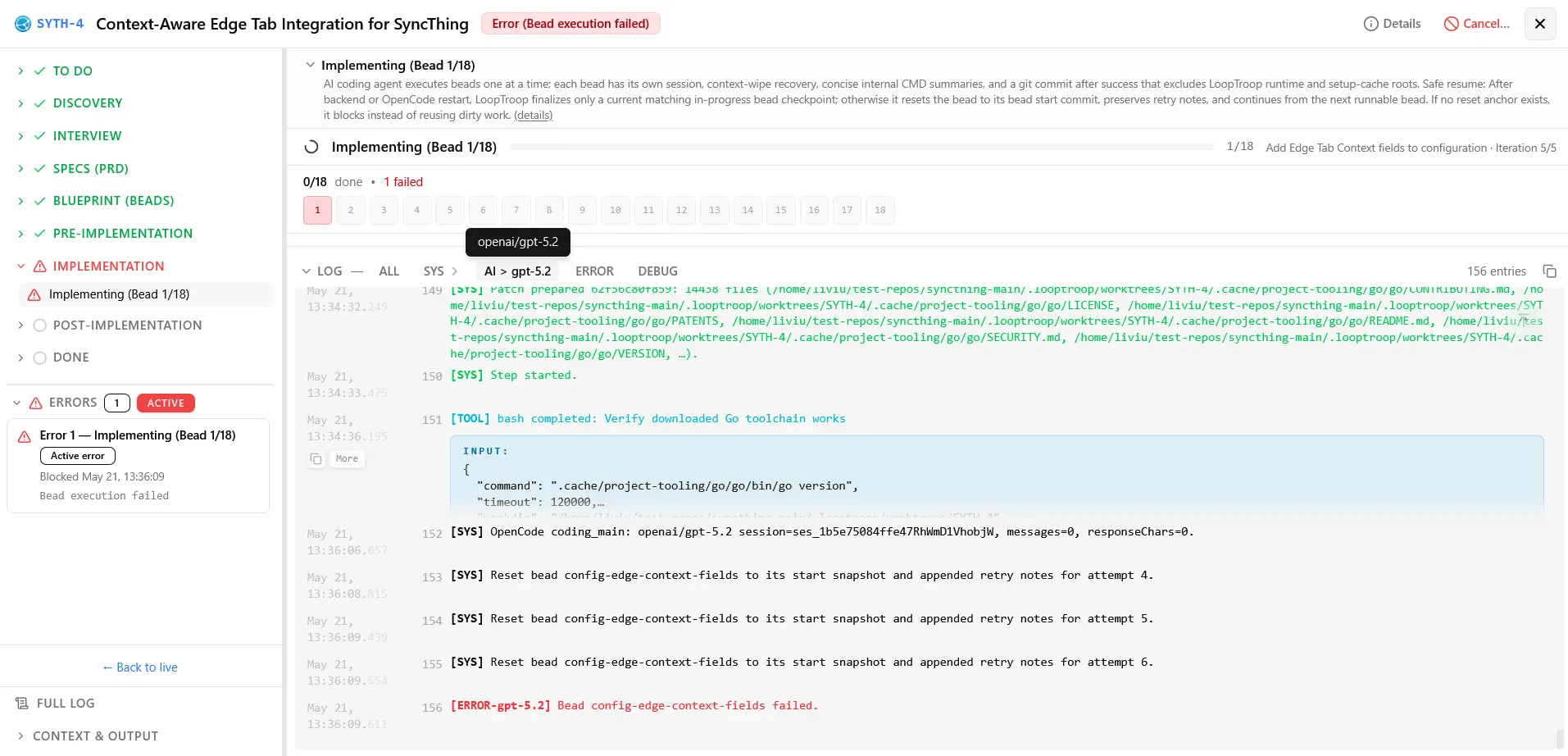 Review the focused workspace view shown when an implementation bead is blocked by an error.
Alternate bead error view
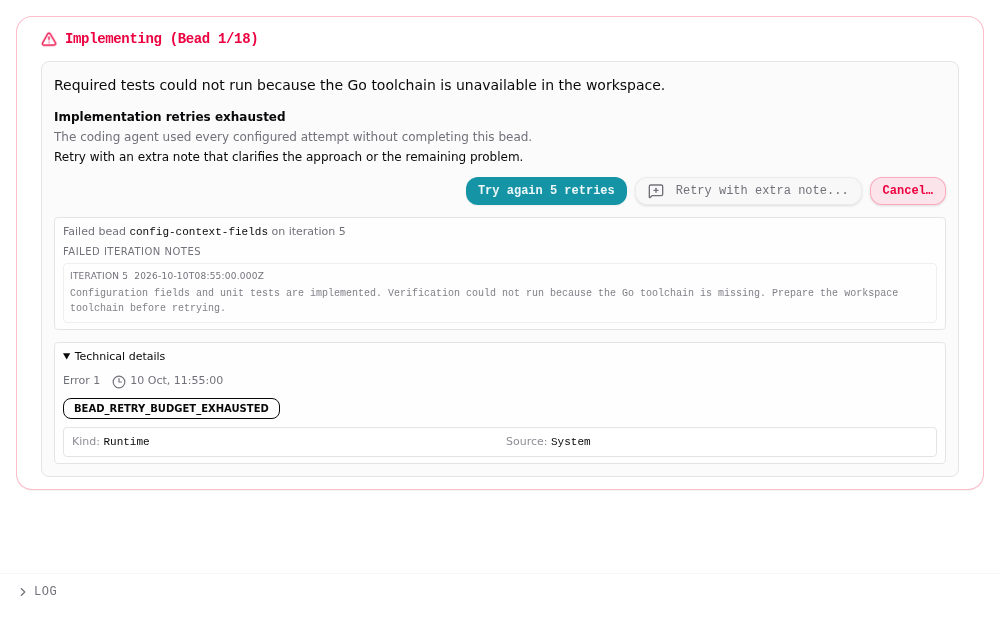 Compare a different bead's error state, diagnostics, and recovery context before deciding whether to continue or retry.
Documentation Map
Start Here
- Getting Started: prerequisites, the first run, and attaching a first project.
- Installation: every channel and what each requires, upgrading, uninstalling, verifying a download, and running in a container.
- Core Philosophy: context engineering, councils, retries, and approvals.
- Context Engineering: why prompts are built from minimal per-status context and what each status receives.
Workflow
- Ticket Flow & State Machine: end-to-end ticket lifecycle, state machine transitions, artifacts, user actions, retries, and outcomes.
- Ticket Lifecycle Screenshots: visual walkthrough of every workflow status with screenshots and quick action summaries.
- Interview: adaptive clarification batches, skipped questions, coverage follow-ups, artifact structure, and approval.
- PRD: Full Answers, skipped-answer resolution, council drafting/voting/refining, PRD structure, coverage, and approval.
- LLM Council: draft, vote, refine, and coverage orchestration.
- Beads & Execution: execution-unit model, dependency graph, execution loop, bounded Ralph-style retry, storage, and diff review.
- Pre-Implementation: pre-flight readiness checks, setup-plan approval and rewind semantics, temporary runtime setup, and reusable execution-profile artifacts.
- Post-Implementation: final testing, file effects audit, integration squashing, pull request publishing, and worktree cleanup.
Architecture
- System Architecture: current runtime architecture, storage ownership, module map, lifecycle.
- OpenCode Integration: adapter, sessions, reconnect, stream handling.
- Frontend: workspace composition, navigation, hooks, live updates.
- Database Schema: app DB, project DB, ownership boundaries.
Reference
- Configuration: all profile settings with defaults, ranges, and trade-offs.
- CLI Reference: every
looptroopcommand and option, the--jsonoutput, and what running as a service means. - Prompt Inventory: built-in prompts, collapsed full prompt content, runtime prompt builders, workflow usage, tool policies, and context inputs.
- API Reference: routes, SSE events, payload shapes.
- Output Normalization: how malformed or partial model output is repaired or isolated before use.
Operations
- Operations Guide: startup maintenance, environment variables, runtime storage, diagnostics, and project cleanup.
- Runtime Diagnostics: stall reports, blocked-error payloads, and structured retry surfaces.
Direction
- Changelog: project release notes and historical changes.
- Roadmap: living planning notes for priorities and future directions.
Terminology Notes
LoopTroop uses a mix of established and newer terms:
- Bead: the smallest, independently implementable unit of work. Borrowed from Steve Yegge's Beads Project methodology. Each bead contains a clear purpose, acceptance criteria, target files, and validation steps.
- git worktree: a standard Git capability for working on multiple linked trees from one repository. LoopTroop uses it as the main execution-isolation primitive.
- Ralph-style retry: community shorthand for abandoning a degraded coding session, keeping a compact failure note, and retrying in fresh context instead of continuing the same transcript.
- LLM council: LoopTroop's name for its multi-model draft, vote, and refine pattern. The idea overlaps with newer multi-model consensus research, but the exact workflow here is LoopTroop-specific.
- PRD: Product Requirements Document. The structured spec (epics + user stories) that the LLM Council produces from your ticket and interview answers before any coding starts.
- AI orchestrator: descriptive, not magical. In this repo it means a system that owns workflow state, artifact boundaries, retries, approvals, and delivery mechanics around model calls.